Draw Joust!
- 4.3
- Rating
- 100.00M
- Installs
- Free
- Price
 Analysis by App-foxy
I spent time with Draw Joust expecting a quick sketch-and-fight game, and that is exactly where it works best. The basic idea is wonderfully easy to understand: draw a vehicle, attach wheels, and send it into a short arena battle. The challenge is not artistic quality. It is making a design that can move, survive contact, and give you a useful advantage against the opponent.
That simple loop makes this an appealing action game for short breaks. I can play a round while waiting for a coffee or use it as a quick change of pace between longer games. It is free to download, carries an Everyone 10+ age rating, and comes from VOODOO, a developer well known for compact mobile games that are easy to start without a long tutorial.
The current release is version 5.6.0, and the game has reached more than 100 million installs. Its average rating sits at 4.3 from roughly 335 thousand ratings, with about 8.4 thousand written reviews. Those figures suggest a broad audience, but they do not change my main conclusion: this is best approached as a playful, bite-sized experiment rather than a deep competitive vehicle builder.
You May Also Like

 Blood Strike: 2.5 Anniversary
Blood Strike’s Loadouts Turn Every Drop Into a Tactical Gamble
A close look at Blood Strike’s custom loadouts: how fast access to signature weapons reshapes its battle royale rhythm, rewards preparation, and narrows the gap between fights.

 Pandora - Music & Podcasts
Pandora’s Music Is Easy to Start, but Harder to Recover
Pandora’s strength is its low-effort path from a seed to a station. Its weak spot is how much confidence it asks you to place in connection, setup, and quiet recovery.

 8 Ball Pool
 Is Built on Rivalries, Rematches, and Routine
A close look at the rivalries, rematches, shared routines, and unanswered safety questions that turn a quick pool match into a persistent mobile community.

 Samsung Music
’s Quiet Strength Is Playing What You Already Own
Its reach comes less from spectacle than from dependable access to a personal library. That simplicity is both the app’s strongest retention engine and its ceiling.

 AccuWeather: Weather Radar
AccuWeather Review: A Quick, Clear Forecast for Everyday Decisions
For everyday plans, the best forecast is the one you can understand quickly. AccuWeather makes rain timing, radar, and local conditions easy to act on, with a few trade-offs.

 Hill Climb Racing
Why Hill Climb Racing Still Turns Crashes Into One More Run
A tiny car, a bumpy hill and one more upgrade: Hill Climb Racing keeps resurfacing because its simple chaos makes every near-miss feel personal.
More From Our News Desk



How the drawing battle actually feels
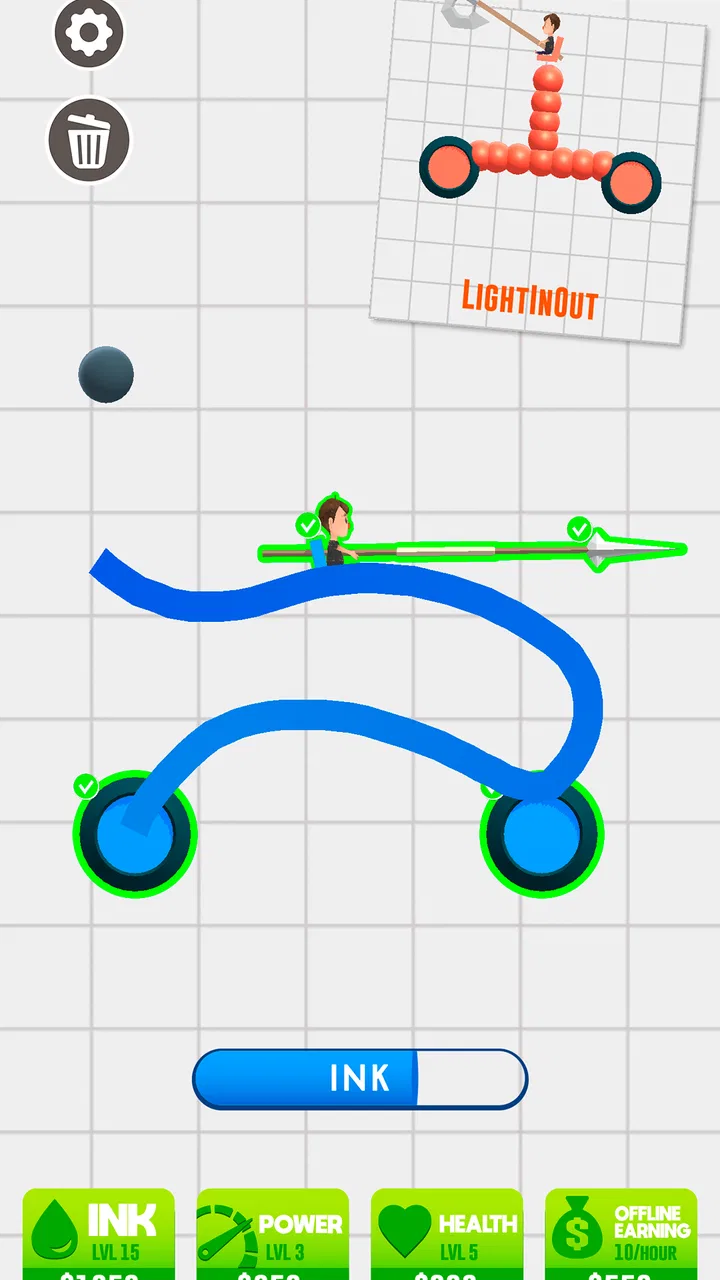
Each round begins with a blank space where I create the shape of my cart. The drawing is the important decision, but it is also the most tempting place to overthink. A huge design may look powerful yet behave awkwardly. A tiny shape can be nimble but leave me vulnerable. The useful question is not “What looks strongest?” but “What will still work once it starts rolling and colliding?”
Once the design is ready, the battle becomes a test of momentum and contact. I watch the vehicle move, see how the wheels respond, and learn from the way the shape reacts when it meets the opposing cart. That gives the game a pleasant trial-and-error rhythm. I am not simply tapping an attack button; I am adjusting a physical idea and seeing whether it survives.
The controls are approachable because the drawing phase does most of the work. There is no complicated control scheme to memorize, which makes the game suitable for people who do not usually play action titles on a phone. At the same time, the drawing mechanic gives experienced players something to refine. Small changes to proportions can make a design feel more stable or more aggressive.
One of my favorite parts is that the game turns failure into information. If the cart tips immediately, I know the shape needs better balance. If it reaches the opponent but cannot push effectively, I can rethink its front edge or overall weight distribution. The game never needs to explain every possibility for me to understand the lesson because the result is visible right away.
Why simple sketches can outperform impressive ones
A useful early habit is to draw with the next collision in mind. Long, thin extensions may appear threatening, but they can also catch on the ground or make the vehicle rotate at the wrong moment. A compact body with a clear front often feels more dependable than a complicated outline. I found that reliable movement usually mattered more than creating the most dramatic silhouette.
Another practical tip is to avoid changing everything after every loss. If I alter the body, wheel position, and shape at once, I cannot tell what improved the result. Changing one part at a time turns the game into a small experiment. That approach is especially helpful when a level seems to punish the same mistake repeatedly.
There is also a trade-off between reach and control. A longer design may make contact sooner, but it can become difficult to steer through the collision. A shorter design gives up some reach while staying easier to manage. I would not call one style universally best; the enjoyable part is discovering which compromise suits the current encounter.
A good fit for short sessions
This is the kind of game I would recommend to someone who wants immediate interaction rather than a long campaign to learn. A realistic use case is a ten-minute break during the day: I can play a few rounds, try one new shape, and stop without losing the thread of a large story. The game’s compact structure makes it convenient when attention is divided.
It also works as a casual game to share with a younger family member, provided the player is comfortable with the Everyone 10+ rating. The drawing idea is easy to demonstrate, and watching a strange homemade vehicle behave badly can be as entertaining as winning. It encourages curiosity more than precision, which gives it a friendly tone even when a design fails.
However, I would not choose it for a long uninterrupted gaming session every day. The central idea is strong, but it is also narrow. Once I had experimented with several approaches, the novelty of drawing another cart could fade. Players who need a detailed progression system, extensive customization, or a story-driven reason to continue may find the loop too lightweight.
What the latest version means in practice
The version available now is 5.6.0, which is useful context for anyone deciding whether to install it today. The game is not being presented as an untouched launch experiment; it has had time to establish its current form since its release on April 7, 2020. That history helps explain why the core interaction feels focused rather than overloaded with unrelated systems.
For an existing player, the sensible approach is to treat the current version as a stable snapshot of the game’s main identity: draw, test, collide, and adjust. I would not return expecting a completely different genre or a large strategic management layer. The appeal remains in the physical comedy and the small design decisions made before each battle.
That distinction matters when reading update expectations. A new version number can signal ongoing maintenance, but it is not a promise that every personal request has been addressed. I would install 5.6.0 for the current drawing-and-battle experience, not because I expect it to transform into a full vehicle simulator or a traditional fighting game.
For new users, the current release also makes the entry point straightforward. There is no need to understand a complicated backstory before trying the mechanic. I can begin with an ordinary shape, observe the result, and improve through direct feedback. That immediate learning curve is one of the strongest reasons to recommend it.
Where it differs from familiar action games
Compared with traditional mobile fighting games, this title gives me less direct control during the actual clash. In a conventional fighter, timing attacks, blocking, and movement are usually the main skills. Here, much of the strategy happens before the battle, when I decide what kind of machine I am sending in. Players who enjoy preparation and experimentation may prefer that change of emphasis.
It also differs from racing games. Speed alone is not the entire goal, and a sleek-looking vehicle is not automatically useful. The cart has to cope with contact, which means a design that would be excellent on a clean track may be poor in a collision. That makes the game feel closer to a sketching puzzle wrapped in action than to a standard race.
Compared with construction or sandbox games, the experience is much more immediate but far less expansive. I do not approach it expecting a workshop where I can spend an hour building a machine piece by piece. Its strength is the fast feedback: draw something, see what it does, then decide whether the next attempt should be bolder or simpler.
That comparison also clarifies who should skip it. If you want precise manual driving, deep equipment statistics, or a large world to explore, another action or racing game will probably serve you better. If you enjoy seeing a quick idea become a chaotic physical object, this unusual format has more personality than its simple presentation might suggest.
Small techniques that make experimentation better
I recommend beginning with a deliberately conservative design rather than trying to create a perfect champion immediately. A stable base teaches me how the arena treats movement and impact. After that, I can introduce one unusual feature in the drawing and see whether it creates a benefit or merely makes the cart harder to control.
It is also worth paying attention to the first seconds of a round. The opening movement often reveals whether the design is balanced before the main collision happens. If the cart already leans, drags, or turns unexpectedly, the problem is probably in the drawing rather than in the opponent. This saves time because I can correct the design instead of repeatedly blaming the battle.
When a design succeeds, I would still avoid assuming it will work everywhere. A shape that performs well against one kind of contact may struggle when the angle changes. Keeping a mental note of what the design is good at—stability, reach, or pushing power—helps me choose the next experiment with a purpose instead of drawing randomly.
The most interesting trade-off is that stronger-looking designs can create their own weaknesses. Extra length may expose the cart to awkward rotations, while a heavier-looking outline may reduce the clean movement I need to reach the opponent. The game rewards practical sketches, not decoration. That is a surprisingly useful lesson for a title that appears so casual at first glance.
Free access and the practical limits
The game is free, which makes trying it an easy decision for most curious players. There are in-app purchases ranging from $0.99 to $99.99 per item, so I would still recommend checking the purchase flow before handing the phone to a child. The free entry point is attractive, but optional spending means it is worth keeping normal mobile-game caution in mind.
My own advice is to play the opening sessions without treating purchases as part of the core experience. First decide whether the drawing loop itself is enjoyable. If the central mechanic does not hold your attention, extra spending will not solve that problem. If it does appeal to you, you can make a more informed choice about whether any optional item is worth considering.
Another limitation is the dependence on repeated physical experiments. Some players will find that relaxing; others may see it as trial and error without enough control. The game asks me to accept imperfect outcomes and try again. That is fine during a short break, but it can become frustrating if I want every result to feel predictable or skill-based in a traditional sense.
The visuals and concept are also likely to divide people. The rough drawing style is part of the charm, yet anyone looking for polished realism may find it too playful. I think the deliberately simple presentation supports the humor, but it does not offer the visual spectacle of a larger action production.
Who will enjoy it most
I would point this game toward casual players, creative tinkerers, and anyone who likes physics-based surprises. It is especially good for people who enjoy asking “What happens if I change this one part?” rather than following a fixed optimal strategy. The low barrier to entry means a player can understand the premise quickly, while the drawing decisions provide enough room for personal style.
It is less suitable for players who need a strong narrative, long-term character development, or highly precise combat controls. Competitive-minded users may also want to know that the satisfaction comes from improving designs and reading outcomes, not from mastering a large set of attacks. That difference is important because the store category alone does not fully describe the experience.
For families, I would keep the age rating in view and supervise purchases rather than assuming that a cartoon-like presentation answers every concern. For adults, the more relevant question is patience: can you enjoy repeating a small experiment without needing constant new content? If yes, the game can be an excellent casual distraction. If not, its compact loop may feel repetitive sooner than expected.
What I would like to see going forward
The current version gives the game a clear identity, and I would rather see future changes deepen that identity than bury it under complexity. More meaningful reasons to revisit successful designs would be useful, provided they do not turn the quick drawing phase into a slow setup process. The best future direction would preserve the immediate “draw and discover” feeling.
I would also watch how the balance between experimentation and repetition develops. The mechanic is strongest when each attempt teaches me something. If later progress ever depends too heavily on repeating the same reliable shape, some of the creative appeal could weaken. The game should keep rewarding a clever adjustment, not only a memorized solution.
For someone installing now, my expectation would be modest and specific: a free action game built around quick sketches, physical collisions, and amusing failures. I would not buy it for a deep campaign or a replacement for a full fighting game. I would install it because the idea of designing a cart and immediately discovering its flaws is genuinely fun.
After playing, I see Draw Joust as a focused little game with a clear strength: it turns a few lines on a screen into a surprisingly personal battle machine. Its best moments come from practical creativity, especially when a simple design beats a more ambitious one. Its main weakness is the same narrowness that makes it accessible; players seeking lasting depth may outgrow it.
My recommendation is straightforward. Try it if you want a free, low-commitment action game that gives you something to think about before each collision. Start with stable shapes, change one idea at a time, and judge the game by the fun of experimentation rather than by the promise of a large progression system. For that specific mood, VOODOO’s compact design is easy to recommend.
FAQs for Draw Joust!
01What is the main objective of Draw Joust!?
In Draw Joust!, the primary goal is to construct and customize your own vehicle using various shapes and components. Once your vehicle is ready, you engage in combat against opponents, trying to knock them off their platforms. Strategy and creativity play key roles in designing effective vehicles to win battles.
02Is Draw Joust! suitable for all age groups?
Draw Joust! is designed to be accessible and enjoyable for players of all ages. Its intuitive controls and simple mechanics make it easy for younger players to grasp, while the strategic elements and creative vehicle design can engage older audiences. However, parental guidance is recommended for very young children due to the combat aspect.
03Does Draw Joust! require an internet connection to play?
Draw Joust! primarily functions offline, allowing players to enjoy the game without an internet connection. However, some features like in-app purchases or leaderboard functionalities may require connectivity. Playing offline ensures uninterrupted gameplay, especially when traveling or in areas with limited internet access.
04Are there in-app purchases in Draw Joust!?
Yes, Draw Joust! offers in-app purchases that enhance gameplay. These may include additional components for your vehicle, cosmetic upgrades, or power-ups. While purchases can enhance the experience, they are not necessary to progress through the game. Players can enjoy the full game without spending money.
05How does Draw Joust! compare to other drawing games?
Draw Joust! stands out by combining drawing mechanics with action-packed combat. Unlike traditional drawing games that focus solely on creativity, Draw Joust! requires players to build functional vehicles for battle. This unique blend of creativity and strategy provides a refreshing twist and keeps gameplay exciting and engaging.
Pros
- Intuitive controls make gameplay accessible.
- Creative design with diverse vehicle options.
- Challenging levels enhance replayability.
- Vibrant graphics and engaging sound effects.
- Regular updates keep content fresh.
Cons
- In-app purchases can be costly.
- Occasional ads disrupt gameplay flow.
- Limited multiplayer interaction features.
- Some levels feel repetitive over time.
- Requires internet for certain features.

Draw Joust!
Gallery